
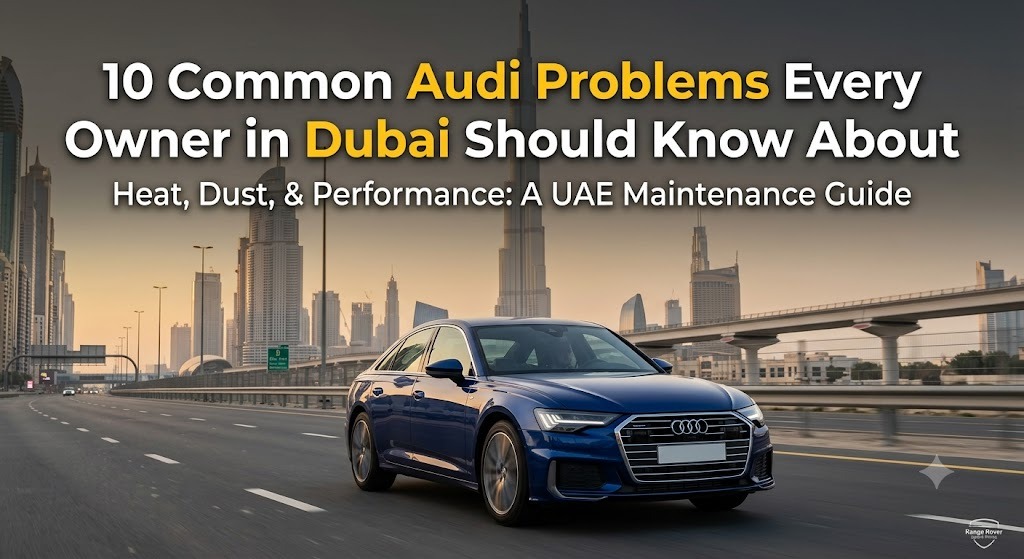
Audi builds some of the most refined vehicles on UAE roads, but even German engineering has its weak points — and Dubai’s climate has a way of finding them faster than almost anywhere else in the world. Between 45°C summer heat, fine desert dust, stop-and-go Sheikh Zayed Road traffic, and long highway runs to Abu Dhabi, an Audi in Dubai works harder than the same car in Munich or London.
If you own an A4, A6, Q5, Q7, Q8, or any S/RS model, understanding the most common failure patterns can save you thousands of dirhams and keep small issues from becoming engine-out repairs. Here are the ten problems Audi technicians in the UAE see most often.
1. Excessive Oil Consumption (EA888 and Older TFSI Engines)
The 2.0 TFSI engines fitted to many A4, A5, and Q5 models — particularly 2009 to 2016 builds — are notorious for burning oil. Worn piston rings and undersized ring drain holes allow oil past the pistons, and owners often find themselves topping up a litre every 1,500 to 2,000 km. In Dubai’s heat, thinner hot oil makes the problem worse.
Ignore it and you risk fouled spark plugs, damaged catalytic converters, and eventually low-oil engine damage. The proper fix ranges from updated PCV valves to full piston-and-ring replacement, so an accurate diagnosis matters before you commit to a repair bill.
2. Timing Chain Tensioner Failure
Older 2.0 TFSI and some V6 engines used a timing chain tensioner design that can fail, allowing the chain to skip teeth. The warning sign is a rattle on cold start that disappears after a few seconds. In a garage this is a few hours of labour and a tensioner kit; ignored, it becomes bent valves and a rebuilt cylinder head. If your Audi rattles on startup, don’t wait.
3. Air Conditioning Compressor and Condenser Problems
No surprise in the UAE: the AC system is under maximum load for eight months of the year. Common Audi-specific issues include failing compressor clutches, leaking condensers (sand-blasted by highway debris), and blend door actuator faults that leave one side of the cabin blowing warm. Weak cooling, clicking noises behind the dashboard, or a musty smell all warrant inspection before peak summer arrives.
4. Mechatronic and S-Tronic Transmission Faults
Audi’s dual-clutch S-tronic (DL501 and related units) delivers brilliant shifts when healthy, but the mechatronic unit — the transmission’s brain and hydraulic control block — is sensitive to heat and old fluid. Symptoms include jerky low-speed shifts, hesitation from a standstill, flashing PRNDS lights, or the car dropping into limp mode. Dubai’s stop-start traffic accelerates fluid degradation, which is why S-tronic fluid and filter changes every 60,000 km (not the “lifetime fill” some owners assume) are essential here.
5. Coolant Leaks from Plastic Components
Audi uses plastic thermostat housings, water pumps with composite impellers, and plastic coolant flanges throughout its engine range. Under sustained Gulf heat, these components become brittle and crack. The 2.0T water pump/thermostat module is a particularly frequent failure. A low coolant warning should never be topped up and forgotten — overheating an Audi engine, especially an aluminium-block V6 or V8, is one of the fastest routes to a five-figure repair.
6. Carbon Buildup on Intake Valves
Direct-injection TFSI and FSI engines spray fuel straight into the cylinder, which means the intake valves never get washed by fuel. Over 60,000–100,000 km, carbon deposits build up on the valves, causing rough idle, misfires, hesitation, and reduced fuel economy. Walnut-shell blasting of the intake ports is the established fix and makes a noticeable difference to how the engine drives.
7. Suspension and Air Suspension Wear
Q7, A8, and allroad models with adaptive air suspension face compressor wear and air strut leaks, often announced by the car sitting low overnight on one corner. Standard-suspension cars in Dubai chew through control arm bushings and links faster than usual thanks to speed humps, construction zones, and heat-hardened rubber. Clunks over bumps, vague steering, or uneven tyre wear are the usual clues.
8. Electrical Gremlins and MMI Issues
Modern Audis are rolling computer networks. Battery drain from modules that fail to sleep, MMI screens that freeze or reboot, failing door lock actuators, and parking sensor faults are all routine complaints. Heat shortens battery life dramatically in the UAE — expect two to three years from a battery here, not the five you might get in Europe — and a weak battery alone can trigger a cascade of false warning lights.
9. Turbocharger Wear
Diverter valve failures, wastegate rattle, and worn turbo bearings appear on higher-mileage TFSI engines, particularly cars that have been driven hard and shut down hot without a cool-down. Loss of boost, whistling or whining noises, and blue exhaust smoke are the classic signs. Catching a failing diverter valve early is a cheap fix; a destroyed turbo feeding metal into the engine is not.
10. Brake Wear from Heat and Traffic
Heavy SUVs like the Q7 and Q8, combined with Dubai traffic, mean brake pads and rotors wear quickly. Audi’s electronic parking brake actuators also fail occasionally, and warped rotors from repeated hard stops in summer heat cause steering wheel shudder under braking.
Protecting Your Audi in the UAE Climate
Most of these problems share one theme: heat and deferred maintenance turn small faults into big ones. Shortening oil change intervals to 8,000–10,000 km, servicing the transmission fluid on schedule, testing the battery and cooling system before summer, and acting on early warning signs will keep ownership costs sensible.
When something does go wrong, diagnosis matters as much as the repair itself. Audi’s platforms share parts and fault patterns, and an experienced independent workshop with factory-level diagnostic tools (ODIS/VCDS) can pinpoint issues quickly without dealer pricing. For owners looking for trusted audi repair dubai services, choosing a workshop that specialises in the brand — rather than a general garage — makes a real difference in both accuracy and cost.
Your Audi was built to handle demanding conditions. With the right preventive care and a workshop that knows the brand’s quirks, it will handle Dubai’s conditions for many years and many hundreds of thousands of kilometres.