
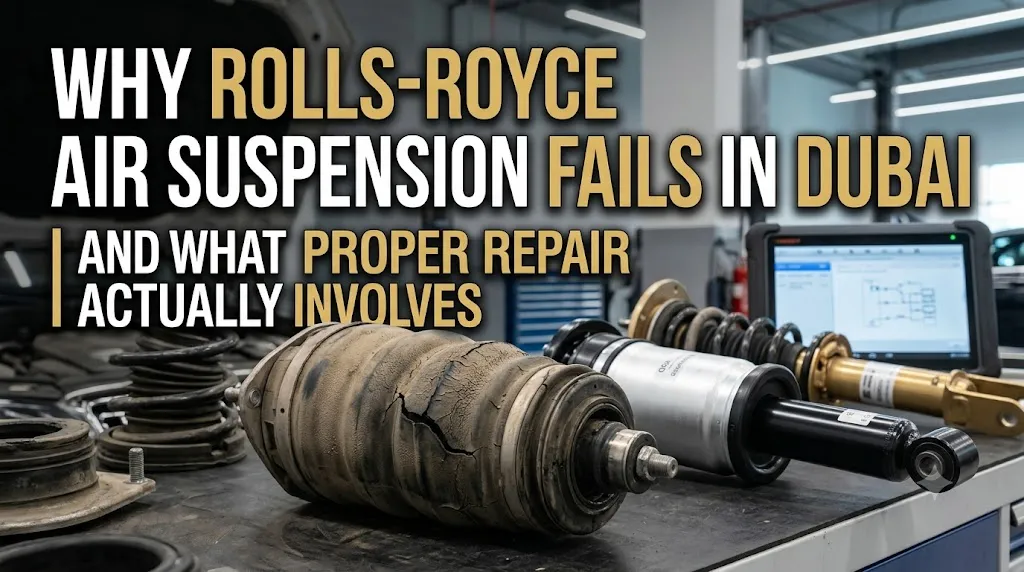
There is a reason Rolls-Royce calls its ride quality the “Magic Carpet Ride.” The self-levelling air suspension fitted to the Phantom, Ghost, Wraith, Dawn, and Cullinan is one of the most sophisticated systems in the automotive world, combining air springs, adaptive electronically controlled dampers, and — on newer models — a camera-based Flagbearer system that scans the road ahead and prepares the suspension for imperfections before the wheels ever reach them.
But sophistication comes at a price, and in the Gulf climate that price arrives sooner than most owners expect. If your Rolls-Royce has started sitting lower on one corner overnight, if the ride has become noticeably firmer, or if a suspension fault message has appeared on the dashboard, this article explains what is happening beneath the car and what a correct repair looks like.
How the System Works
Instead of conventional steel coil springs, each corner of a modern Rolls-Royce rides on an air spring — essentially a reinforced rubber bellows filled with compressed air. An onboard compressor maintains pressure in the system, while ride-height sensors at each wheel constantly report the car’s attitude to a control module. The module adjusts air volume in each spring dozens of times per second, keeping the body level whether the car is carrying one occupant or five, cruising Sheikh Zayed Road or crawling over speed humps in a residential community.
Layered on top of this are electronically adaptive dampers, which vary their firmness in milliseconds. On the Cullinan and current Phantom, the system also raises and lowers the entire car for off-road clearance or easier entry.
Every one of these components — bellows, compressor, valve block, height sensors, dampers, and the control electronics — can fail. And in Dubai, several of them fail early.
Why the Dubai Climate Is So Hard on Air Suspension
Heat degrades rubber. The air spring bellows are made of layered rubber and cord. Sustained ambient temperatures above 45°C in summer, combined with radiated heat from asphalt that can exceed 70°C, accelerate the hardening and micro-cracking of that rubber. What might last twelve years in a European climate can begin leaking after six to eight in the UAE. The leaks usually start as pinholes or cracks along the fold of the bellows — invisible to the eye, but enough to let the car sag overnight.
The compressor works overtime. Once a spring develops even a tiny leak, the compressor runs far more often to maintain ride height. Compressors are designed for intermittent duty; continuous cycling in extreme heat overheats the piston seal and burns out the motor. This is why a leaking air spring, left unrepaired, almost always takes the compressor with it. A repair that could have involved one corner becomes a repair involving the entire pneumatic supply system.
Sand and moisture attack the valve block. The valve block distributes air between the four corners. Fine desert dust that gets past a tired air dryer, combined with condensation from humid coastal air, corrodes valve seats and causes sticking solenoids. The symptom is often uneven ride height that changes seemingly at random.
Chassis electronics suffer in heat. Height sensor connectors and wiring looms become brittle. Intermittent sensor signals confuse the control module, producing suspension warnings that come and go — the most frustrating kind of fault to live with.
The Warning Signs Owners Should Never Ignore
- Overnight sag. The car sits visibly lower on one corner or one end after being parked. This is the classic signature of a leaking air spring.
- Compressor noise. A humming or clicking from the front of the car that runs longer than 30–60 seconds after start-up suggests the compressor is struggling to build pressure.
- A harsh or “crashy” ride. If the famous waftability has disappeared and the car thumps over expansion joints, either the springs are running at incorrect pressure or the adaptive dampers have failed internally.
- Suspension fault messages. Any message referencing self-levelling, ride height, or chassis systems warrants immediate diagnosis. Modern Rolls-Royce models will deliberately limit speed or lock the suspension at a fixed height in a fault condition to protect the system.
- The car leaning through corners more than usual. On Cullinan and Phantom VIII, failure of the electric active anti-roll system produces noticeable body roll that owners often mistake for tyre problems.
Driving on a collapsed air spring is genuinely damaging. The bellows can fold and tear completely, the tyre can contact the arch liner, and the damper takes impacts it was never designed to absorb. If a corner has dropped fully, the car should be recovered on a flatbed, not driven.
What a Proper Repair Involves
A correct air suspension repair on a Rolls-Royce is a diagnostic process first and a parts-replacement process second. The right sequence looks like this:
Full-system electronic diagnosis. Using factory-level diagnostic software, a technician reads fault memory from the chassis control module, checks live data from all four height sensors, and commands the compressor and valve block through test routines. This distinguishes an air leak from an electrical fault — a distinction that matters enormously, because replacing an air spring will not fix a corroded sensor connector.
Pressure and leak-down testing. Each corner is tested for its ability to hold pressure over time. Soapy-water and ultrasonic leak detection pinpoint whether the leak is in the bellows, an airline fitting, or the valve block itself.
Genuine or OEM-specification components. The air springs on a Phantom or Cullinan are model-specific, and the damper units are electronically coded to the vehicle. Cheap pattern parts often have incorrect spring rates and fail again within a year in Gulf heat. A reputable workshop will fit genuine or original-equipment-manufacturer components and be transparent about which is being used.
Compressor and dryer service. Whenever a leak has been present, the compressor should be inspected and the air dryer desiccant renewed. Skipping this step is the most common reason repaired systems fail again within months.
Calibration. After any component replacement, ride heights must be recalibrated with the factory procedure — the car placed on a level surface, sensors zeroed, and target heights programmed. Without calibration, the car may sit crooked or the adaptive dampers may operate on incorrect assumptions.
Choosing the Right Workshop in Dubai
Air suspension work sits at the intersection of mechanical, pneumatic, and electronic skills, and it demands both the diagnostic equipment and the model-specific experience that general garages simply do not have. Dealership service centres do excellent work but at a cost that surprises even Rolls-Royce owners, and often with long waiting times for parts and appointments.
The middle path many owners in the UAE choose is an independent specialist workshop that focuses on Rolls-Royce and maintains factory-grade diagnostic tooling. For owners looking for expert rolls royce repair dubai, the sensible checklist is straightforward: ask what diagnostic platform the workshop uses, ask whether they have rebuilt or replaced air suspension on your specific model before, ask about parts provenance, and ask for a written warranty on both parts and labour.
Prevention: What Owners Can Do
A few habits meaningfully extend suspension life in this climate. Park in shade or underground whenever possible — heat soak while parked does as much damage as driving. Have the system pressure-tested annually, ideally before summer. Wash the underbody periodically to remove salt-laden coastal dust from airline fittings. And treat the first fault message as an appointment, not a suggestion; air suspension problems are dramatically cheaper to fix early.
The Magic Carpet Ride is repairable, restorable, and — with proper care — sustainable even in one of the harshest automotive climates on earth. The key is acting early and putting the car in hands that know exactly what they are looking at.