
Owning a Maserati in Dubai is a statement. The Trident badge, the Ferrari-derived engines in older models, the unmistakable exhaust note — few cars turn heads on Sheikh Zayed Road the way a Ghibli, Quattroporte, or Levante does. But Italian engineering and Gulf weather are not natural allies. Sustained 45°C summers, fine desert dust, high humidity along the coast, and stop-and-go traffic between Downtown and Dubai Marina all put stress on components that were designed and tested primarily on European roads.
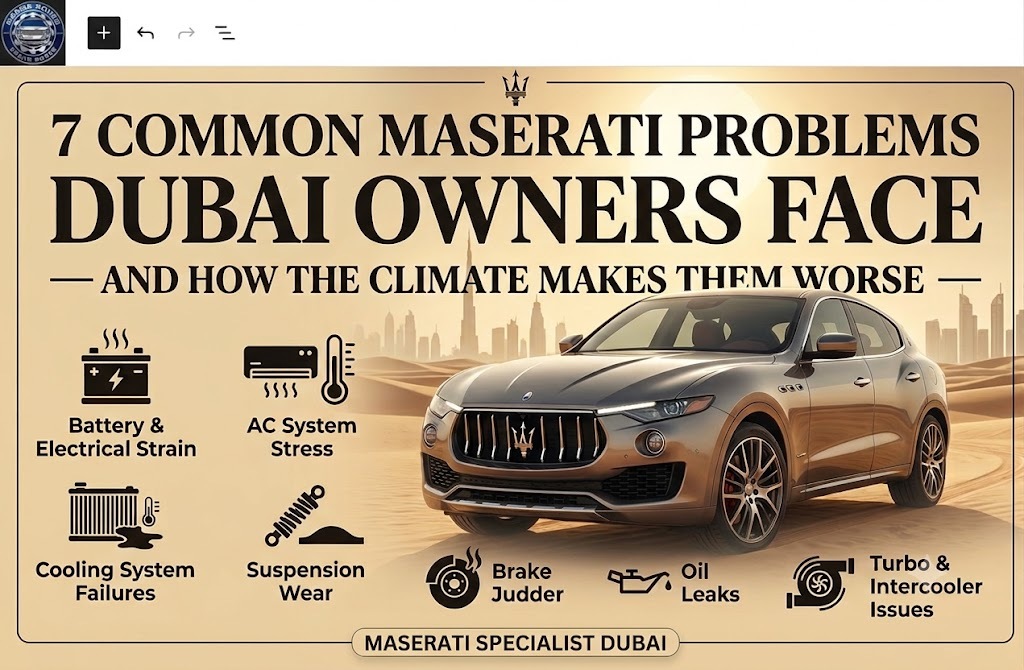
If you drive a Maserati in the UAE, understanding the most common failure points — and how the local climate accelerates them — can save you tens of thousands of dirhams in avoidable repairs. Below are the seven issues we see most often in Maseratis driven daily in Dubai, along with the early warning signs to watch for.
1. Battery Drain and Electrical Gremlins
Maseratis are electronically dense cars, and their batteries suffer badly in Dubai. Extreme heat accelerates the chemical degradation of lead-acid batteries; a battery that might last five years in Milan often fails within 18 to 24 months here. Because Maserati control modules are sensitive to voltage drops, a weak battery does not just cause slow cranking — it can trigger a cascade of seemingly unrelated warnings: transmission faults, parking sensor errors, “Skyhook suspension failure” messages, and infotainment glitches.
Early signs: dashboard warning lights that appear and disappear randomly, slow start after the car has sat for two or three days, windows or seats resetting their memory positions.
What to do: Have the battery load-tested every service. If your car sits in the sun at work all day, consider a battery with higher heat tolerance and make sure the charging system is checked whenever electrical faults appear. Diagnosing the battery first often avoids expensive and unnecessary module replacements.
2. Air Conditioning Strain and Compressor Failure
Nothing gets tested harder in Dubai than a car’s AC system. Maserati compressors, condensers, and blend-door actuators run at maximum load for eight months of the year. Sand and dust clog the condenser fins, reducing heat exchange and forcing the compressor to work even harder. On the Ghibli and Quattroporte, weak airflow or warm air on one side of the cabin is a classic sign of a failing blend-door actuator or a low refrigerant charge caused by a slow leak at the condenser.
Early signs: AC takes noticeably longer to cool the cabin, hissing sounds behind the dashboard, warm air at idle that improves when driving.
What to do: Have the condenser cleaned and the refrigerant pressure checked before every summer. A AED 400 condenser cleaning is far cheaper than a AED 7,000+ compressor replacement.
3. Cooling System Failures — Thermostats, Radiators, and Expansion Tanks
The 3.0L twin-turbo V6 in the Ghibli and Levante, and the V8s in older Quattroportes and GranTurismos, generate serious heat even in mild climates. In Dubai traffic, coolant temperatures climb quickly, and plastic cooling system components — expansion tanks, thermostat housings, radiator end tanks — become brittle years earlier than they would in Europe. A hairline crack in an expansion tank can dump coolant in minutes, and an overheated Maserati engine is one of the most expensive repairs you can face.
Early signs: coolant level dropping between services, sweet smell after parking, temperature gauge creeping higher in traffic, white crust around hose joints.
What to do: Never ignore a low-coolant warning. Pressure-test the system annually and replace aging plastic components proactively rather than waiting for a roadside failure in August.
4. Suspension Wear on Speed Bumps and Rough Surfaces
Dubai’s main highways are excellent, but the city’s countless speed bumps, construction zones, and community roads punish low-slung sports sedans. Maserati’s Skyhook adaptive dampers are superb when healthy but expensive when they fail, and control arm bushings on the Ghibli and Quattroporte wear noticeably faster in high heat, which hardens and cracks the rubber.
Early signs: clunking over speed bumps, the car feeling floaty or crashy compared to before, uneven tyre wear on the inner edges, a “Suspension Failure” message on the cluster.
What to do: Have the suspension inspected on a lift every 10,000 km. Replacing bushings early protects tyres and prevents alignment problems that accelerate wear on other components.
5. Brake Judder and Premature Pad Wear
High ambient temperatures mean Maserati brakes in Dubai operate closer to their thermal limits, especially with spirited driving. Add frequent hard stops in traffic, and warped or unevenly worn discs are common. Owners often report a vibration through the steering wheel when braking from highway speeds — classic disc thickness variation.
Early signs: steering wheel shimmy under braking, squealing at low speed, a soft or long brake pedal.
What to do: Use quality OEM-spec pads and discs. Cheap aftermarket brakes fade quickly in this climate, and on a car with this much performance, brakes are not a place to economise.
6. Oil Leaks and Gasket Degradation
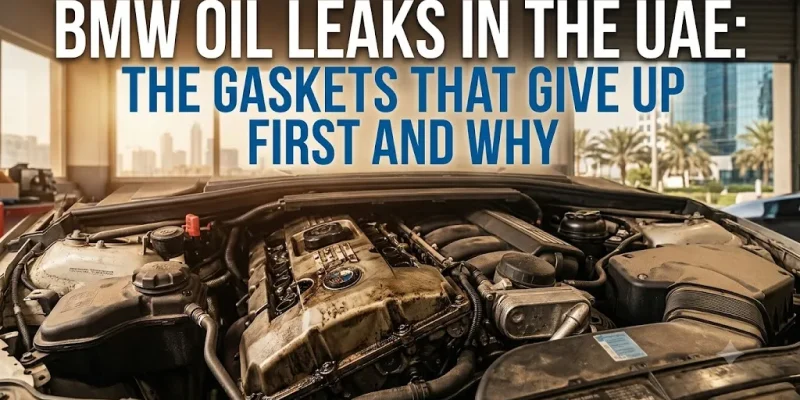
Heat cycles are brutal on gaskets and seals. Valve cover gaskets, timing cover seals, and oil cooler lines on Maserati V6 and V8 engines harden and begin weeping oil, often first noticed as a burning smell after highway driving or small spots on the garage floor. Left alone, a minor weep can become a major leak that starves the engine of oil or coats the alternator and belts.
Early signs: burning oil smell, oil spots where you park, oil level dropping between services without visible smoke.
What to do: Address leaks when they are small. Resealing a valve cover is a routine job; replacing an alternator destroyed by oil contamination is not.
7. Turbocharger and Intercooler Issues on Twin-Turbo Models
The Ghibli and Levante’s twin-turbo V6 relies on effective intercooling — hard to achieve when the intake air is already 45°C. Dust ingestion through neglected air filters accelerates turbo wear, and heat soak reduces performance and increases stress on wastegate actuators.
Early signs: loss of boost or power, whistling or whining that changes with RPM, blue-grey smoke on acceleration.
What to do: Replace air filters more frequently than the official schedule suggests — Dubai dust clogs them fast — and investigate any check-engine light related to boost pressure immediately.
The Bottom Line: Preventive Care Beats Crisis Repair
Every problem on this list is dramatically cheaper to prevent than to fix after failure. The single best thing a Dubai Maserati owner can do is establish a relationship with a workshop that sees these cars every day, understands how the Gulf climate changes their maintenance needs, and has the factory diagnostic tools to read Maserati systems properly. For expert maserati repair dubai, choose a specialist workshop with genuine Maserati diagnostic equipment and technicians who work on these engines daily rather than a general garage that sees one Trident a month.
A Maserati that is proactively maintained in Dubai will reward you with years of reliable, exhilarating driving. One that is serviced only when warning lights force the issue will steadily drain your wallet. In this climate, the choice between those two ownership experiences comes down to the quality and frequency of the care your car receives — so choose your workshop carefully, service on time, and your Maserati will keep turning heads for years to come.