
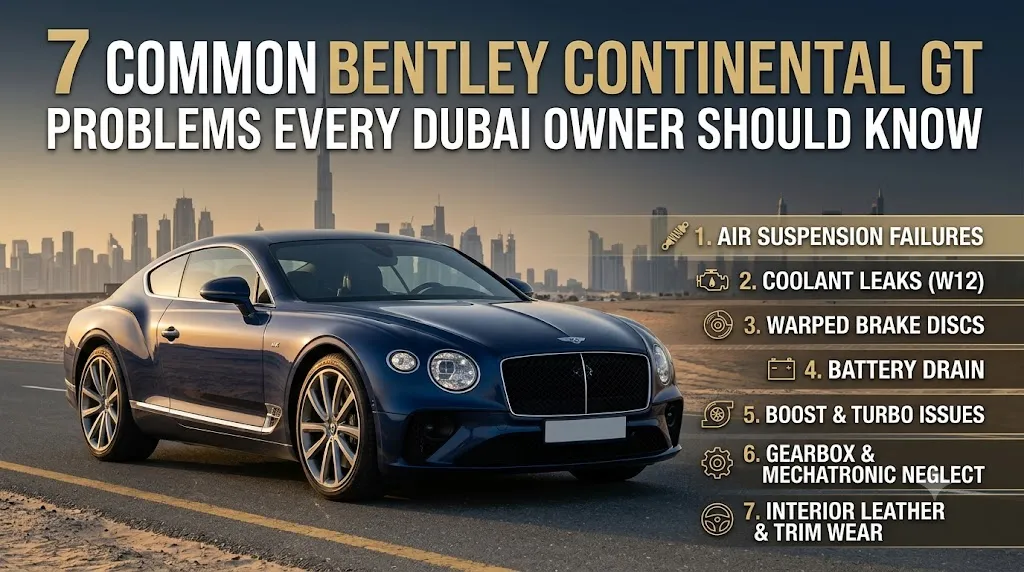
The Bentley Continental GT is one of the most popular luxury grand tourers on Dubai roads, and for good reason. It blends handcrafted British luxury with serious performance, whether powered by the legendary 6.0-litre W12 or the more recent 4.0-litre twin-turbo V8. But like any high-performance machine, the Continental GT has its known weak points — and Dubai’s extreme climate tends to accelerate several of them.
If you own a Continental GT, or you’re thinking of buying one in the UAE pre-owned market, this guide covers the seven most common problems reported by owners and workshops across Dubai, along with what each repair typically involves.
1. Air Suspension Failure
The Continental GT rides on an adaptive air suspension system, and this is arguably the single most common repair item on cars over five years old. The air struts contain rubber bladders that harden and crack over time, and Dubai’s heat dramatically shortens their lifespan compared to European climates.
Symptoms to watch for:
- The car sits lower on one corner after being parked overnight
- A “suspension fault” warning on the dashboard
- The compressor running longer than usual or making a laboured noise
- A noticeably harsher or floatier ride than normal
When one strut fails, the compressor works overtime to compensate, which often kills the compressor next. That is why experienced technicians usually recommend replacing struts in axle pairs and inspecting the compressor and valve block at the same time. Genuine struts are expensive, but high-quality OEM-equivalent units from the original suppliers can cut the cost significantly without compromising ride quality.
2. Coolant Leaks on the W12 Engine
The W12 is a magnificent engine, but it is essentially two narrow-angle V6 engines merged onto one crankshaft, which makes it extremely compact — and extremely hot. Plastic coolant pipes, thermostat housings, and the coolant transfer pipes at the rear of the engine become brittle with age and heat cycles.
In Dubai, where under-bonnet temperatures are punishing for most of the year, coolant leaks tend to appear earlier than they would in cooler markets. Small leaks often start at the plastic Y-pipes and hose junctions. Left unattended, they can lead to overheating, head gasket stress, and repair bills many times larger than the original fix.
If you smell coolant after parking, see low coolant warnings, or notice pink/purple residue around hose joints, have the cooling system pressure-tested promptly.
3. Brake Wear and Warped Discs
The Continental GT weighs around 2.2 to 2.4 tonnes depending on the model year, and Dubai driving — repeated hard stops from highway speeds in stop-start traffic — is brutal on brakes. Owners commonly report steering wheel vibration under braking, which usually indicates disc thickness variation (often called “warped discs”).
Cast iron discs on a Continental GT are large and consumable. Many owners in the UAE upgrade to carbon ceramic brakes or drilled performance discs, but the honest advice from most workshops is simpler: use quality discs and pads matched to the car, and bed them in properly. Cheap brake parts on a car this heavy and fast are a false economy — and a safety risk.
4. Battery Drain and Electrical Gremlins
Bentleys are packed with control modules, and the Continental GT is known for parasitic battery drain, especially on cars that sit unused for weeks — common in Dubai, where many owners have multiple cars or travel frequently. A weak battery causes a cascade of strange faults: random warning lights, infotainment glitches, windows and seats misbehaving, and even gearbox warnings.
Before chasing expensive module repairs, any competent workshop should first load-test the battery and check the charging system. A surprising number of “major electrical faults” on Continental GTs are resolved with a healthy AGM battery and a proper fault-code reset. If your car sits for long periods, a maintenance charger is one of the cheapest forms of insurance you can buy.
5. Turbocharger and Boost System Issues
Both the W12 and V8 Continental GTs are turbocharged, and turbo systems suffer in heat. Common issues include boost leaks from perished hoses, sticking wastegate actuators, and diverter valve failures. Symptoms include reduced power, a whistling or fluttering noise under acceleration, and check-engine lights with boost deviation codes.
Turbo replacement on a W12 is a significant job due to access, so early diagnosis matters. A smoke test of the intake system is a quick, inexpensive way to find leaks before assuming the worst.
6. Gearbox Mechatronic and Fluid Neglect
Earlier Continental GTs use a ZF 6-speed automatic; later cars use the 8-speed or the dual-clutch transmission shared with the Porsche Panamera platform. All of them are robust — if the fluid is changed. The “sealed for life” fluid myth has killed more luxury car gearboxes than any design flaw.
In Dubai’s heat, transmission fluid degrades faster. Harsh shifts, hesitation from a standstill, or clunks when shifting between Drive and Reverse are early warnings. A fluid and filter service every 60,000 km (or sooner for hard-driven cars) is far cheaper than a mechatronic unit or clutch pack replacement.
7. Interior Wear: Leather, Trim, and Sunroof Seals
Finally, the cabin. Dubai’s UV exposure fades and dries the hides, dashboard leather can shrink and lift, and sunroof seals harden, causing wind noise or leaks during the rare rains. None of this affects reliability, but on a car whose value lies partly in its handcrafted interior, cosmetic neglect directly hits resale value. Regular leather conditioning and window tinting with proper UV rejection make a measurable difference.
Buying a Used Continental GT in Dubai? Inspect First
The pre-owned Bentley market in the UAE offers genuinely tempting prices, but the difference between a well-maintained car and a neglected one can easily be AED 50,000–100,000 in pending repairs. Always insist on a pre-purchase inspection that covers the air suspension, cooling system, gearbox behaviour, fault-code scan, and a battery/charging test at minimum.
Where to Get Your Continental GT Repaired
Main dealer servicing in Dubai is excellent but priced accordingly. The good news is that the UAE has a mature independent specialist scene with factory-level diagnostic equipment and access to genuine and OEM parts at far better rates. For expert bentley repair dubai owners can rely on, choose a workshop that works on Bentleys daily — not occasionally — and that will show you the old parts and explain every job before starting it.
A Continental GT that is maintained proactively is one of the most rewarding cars you can own in the UAE. Most of the problems above are predictable, well-documented, and far cheaper to fix early than late. Know the weak points, service on time, and the car will reward you with exactly the effortless, continent-crushing performance Bentley intended.