
There is a saying among BMW technicians that a BMW engine doesn’t leak oil — it marks its territory. The joke lands because it contains truth: certain oil leaks are so predictable on specific BMW engines that a technician can often diagnose them from the driver’s description alone, before the bonnet is even opened. In the UAE, these leaks appear earlier and progress faster than almost anywhere else in the world, and understanding why helps every owner make smarter maintenance decisions.
Heat Is the Enemy of Every Gasket
Every gasket and seal in an engine is a piece of elastomer — rubber-like material engineered to stay flexible while being squeezed between two metal surfaces. Flexibility is what creates the seal. Heat is what destroys flexibility. Every rubber compound has a rated temperature range, and every hour spent above that range accelerates the chemical process called heat ageing, in which the material hardens, shrinks slightly, and eventually cracks.
In Dubai, an engine bay in summer traffic can be 30–40°C hotter than the same engine bay in Munich. A valve cover gasket rated for a comfortable life of ten years in Europe may become hard and glass-like in five or six years here. This is not a defect and it is not bad luck — it is chemistry, and it affects every car brand. BMWs simply have a few well-known leak points where the consequences of a hardened gasket are more expensive than average.
The Usual Suspects
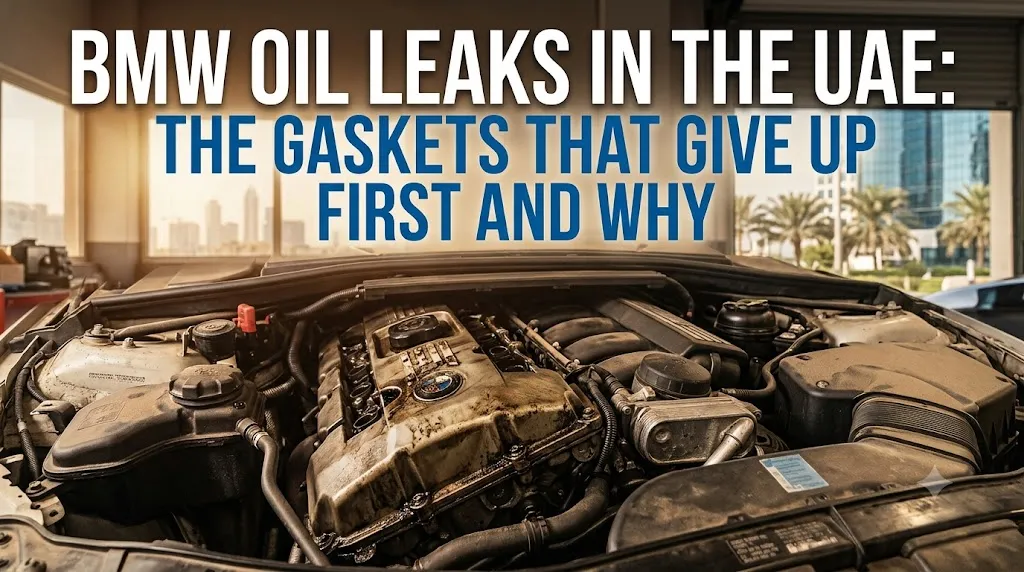
Valve cover gasket. On the four-cylinder N20 and B48 engines and the six-cylinder N52, N55, and B58, the valve cover gasket is the most common leak of all. Early signs are an oil smell after hard driving — oil seeping onto the hot exhaust manifold below — and light misting around the cover’s edge. On the N20 and several other engines, the valve cover itself is plastic and can crack or warp, meaning the fix is sometimes a complete cover, not just a gasket. Left too long, oil can seep into the spark plug wells, degrading ignition coils and causing misfires that owners often misdiagnose as a separate problem.
Oil filter housing gasket. This is arguably the most consequential common leak on six-cylinder BMWs. The oil filter housing bolts to the side of the engine, and its gasket sits directly above the serpentine belt on many models. When it leaks, oil drips onto the belt. An oil-soaked belt can degrade, shred, and — in a failure mode well documented on N52 and N54 engines — get sucked behind the crankshaft pulley and into the front crank seal, sometimes pushing fragments into the oil pan and starving the engine of oil. What starts as a AED 800 gasket job can end as a five-figure engine repair purely because of delay.
Oil pan gasket. Less urgent but persistently annoying, the lower oil pan gasket hardens and weeps, leaving spots on the garage floor. On many models, replacing it requires supporting the engine and, on xDrive cars, sometimes moving front axle components, which is why the labour cost surprises owners.
Front and rear main seals. The crankshaft seals at either end of the engine harden with age and heat. The rear main seal is the expensive one — replacing it requires removing the transmission. A small rear main seep can be monitored; a dripping one on a car you intend to keep should be scheduled for repair, ideally combined with clutch or transmission service to share the labour.
Turbocharger oil lines. On turbocharged engines — which is nearly the entire modern range — the oil feed and return lines to the turbo run through the hottest zone of the entire car. Their crush washers and fittings are frequent seep points, and because the turbo glows red-hot under load, oil dripping onto it produces smoke and a genuine fire risk. Any oil smell accompanied by wisps of smoke from the engine bay deserves same-day attention.
Why “Just Top It Up” Is a Losing Strategy
A surprising number of owners in the UAE manage oil leaks by simply adding a litre every few weeks. This feels economical but carries hidden costs. Leaking oil coats the underside of the engine, attracting sand and dust that form an abrasive paste around seals and sensors. Oil on rubber components — engine mounts, bushings, hoses — swells and destroys them. Oil on the exhaust creates smoke and smell. And critically, a car that is one forgotten top-up away from low oil pressure is a car gambling with its most expensive component. BMW engines with Valvetronic and VANOS systems are especially sensitive to oil level and pressure; low oil triggers cascading faults in these systems that cost far more to repair than the original leak.
Diagnosing Leaks Properly
Because oil travels — blown backward by airflow, spread by the belt, dripped from the lowest point rather than the source — visual inspection alone frequently misidentifies the origin. A competent workshop will degrease the engine, add UV dye to the oil, and run the car before inspecting with a UV lamp. This one-hour process routinely saves owners from paying for the wrong repair. It is common to find a car that received a new oil pan gasket at another garage still leaking because the true source was the filter housing above it, raining oil down onto the pan.
This is where experience with the marque genuinely matters. A workshop that services BMWs daily knows the failure patterns by engine code and mileage, checks the known secondary leak points while the relevant parts of the engine are already apart, and uses the correct torque sequences on plastic covers that crack when over-tightened. If you are seeing oil spots, smelling burnt oil, or watching your oil level drop between services, having the car assessed by a dedicated bmw specialist dubai team is the difference between fixing the actual problem once and chasing symptoms twice.
Prevention: The Realistic Approach
You cannot prevent gasket ageing, but you can slow it and catch it early:
Shorten oil change intervals. BMW’s official condition-based service can stretch intervals to 15,000 km. In Gulf heat, most independent specialists recommend 8,000–10,000 km with a high-quality LL-01 or LL-04 approved oil. Fresh oil maintains the additive package that conditions seals.
Inspect annually with the undertray removed. Most leaks begin as seeps visible only from below. A ten-minute inspection during each oil change catches problems while they are still cheap.
Fix leaks in logical groups. If the valve cover gasket needs doing, and the oil filter housing gasket is fifteen minutes of additional labour away, do both. Combining jobs that share disassembly steps dramatically lowers the lifetime cost of ownership.
Park in shade whenever possible. It sounds trivial, but a car that soaks at 70°C+ under direct sun ages its rubber measurably faster than one parked in a basement garage.
Conclusion
Oil leaks on BMWs in the UAE are close to inevitable — the climate guarantees that gaskets designed in Bavaria will age on an accelerated schedule here. What is not inevitable is the expensive version of the story: the shredded belt, the fouled ignition coils, the smoking turbocharger. Those outcomes belong exclusively to leaks that were noticed and ignored. Treat every new oil spot and every burnt-oil smell as information, get it diagnosed properly with dye rather than guesswork, and repair in sensible groups. Handled that way, oil leaks become a routine, manageable part of ownership rather than the beginning of a horror story.