
Owning a Mercedes-Benz in Dubai is a statement of refinement, but the emirate’s climate is one of the harshest operating environments any European luxury car will ever encounter. Summer asphalt temperatures regularly exceed 60°C, fine desert dust infiltrates every vent and seal, and long stretches of high-speed highway driving on Sheikh Zayed Road push cooling and lubrication systems to their limits. German engineering is superb, but it was calibrated in Stuttgart, not in the Arabian Gulf. That mismatch is why certain failures appear again and again in Mercedes models across Dubai, often far earlier than they would in Europe.
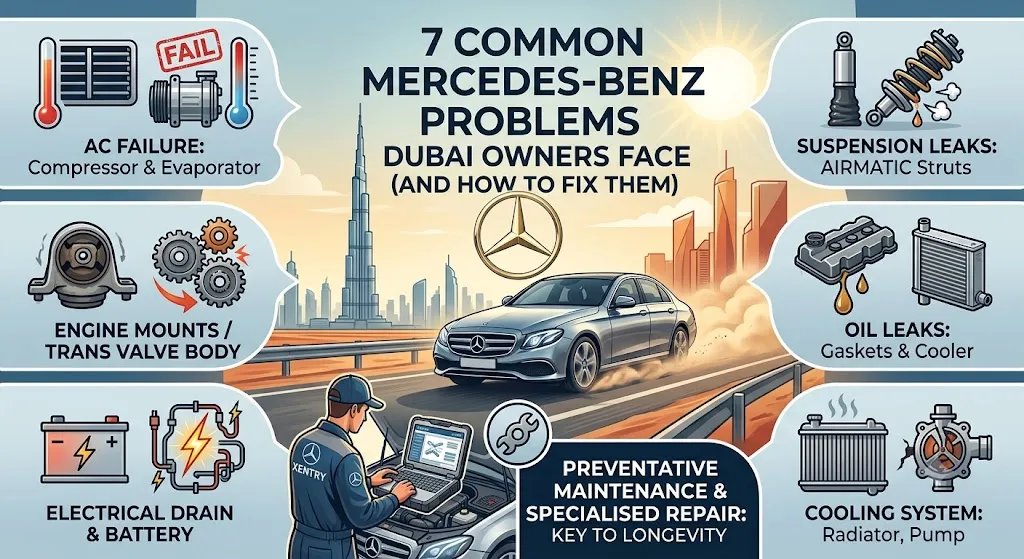
Below are the seven most common problems reported by Mercedes owners in the UAE, what causes them, the warning signs to watch for, and what a proper repair involves.
1. Air Conditioning Compressor and Evaporator Failures
Nothing gets tested harder in Dubai than a Mercedes climate control system. From May through October the compressor runs at near-maximum load every single time the car moves. Over time, the compressor clutch wears, refrigerant seals dry out and leak, and the evaporator — buried deep behind the dashboard — can corrode from condensation mixing with dust.
Warning signs include weak airflow, air that is cool but never cold, a chemical smell from the vents, or a clicking noise when the AC engages. Because evaporator replacement requires removing the entire dashboard on most models (W205, W213, GLE and GLS included), this is a labour-intensive job that should only be trusted to technicians who work on Mercedes daily. A proper repair also includes a full system flush, new receiver-drier, and precise refrigerant charging by weight — shortcuts here guarantee a repeat failure within a year.
2. AIRMATIC Air Suspension Leaks
The S-Class, GLE, GLS, and many E-Class models ride on Mercedes’ AIRMATIC air suspension. The rubber air springs and seals in these struts degrade quickly in extreme heat, becoming brittle and developing micro-cracks. The classic symptom is a car that sags overnight — usually at one corner — or a compressor that runs constantly trying to keep up with a slow leak. Left unattended, the compressor burns out, turning a single-strut repair into a much larger bill.
If your Mercedes sits lower in the morning than it did the night before, have it inspected immediately. Replacing a leaking strut early protects the compressor, valve block, and ride-height sensors.
3. Engine Mount Collapse
Mercedes uses fluid-filled (hydraulic) engine mounts to isolate vibration. Dubai’s heat cooks the fluid and rubber inside them, and on models like the C-Class, E-Class, and ML/GLE, collapsed mounts are almost a scheduled event by 80,000–100,000 km. Symptoms include vibration through the steering wheel at idle, a clunk when shifting between Drive and Reverse, and harshness under acceleration. It’s a straightforward repair when caught early, but ignoring it stresses the transmission mounts, driveshaft, and exhaust hangers.
4. Oil Leaks from Valve Covers and the Oil Cooler
Heat accelerates the hardening of every gasket in the engine bay. On the ubiquitous M272 and M276 V6 engines, valve cover gaskets and the oil cooler seals sitting in the engine’s V are notorious leak points in the Gulf. You may notice oil spots on the garage floor, a burning smell after highway driving, or gradually dropping oil levels. The oil cooler job in particular requires removing the intake manifold, so it pays to replace all surrounding seals in one visit rather than piecemeal.
5. Transmission Valve Body and Conductor Plate Issues
The 7G-Tronic (722.9) gearbox fitted to a huge share of Dubai’s Mercedes fleet is generally robust, but its electrohydraulic valve body and conductor plate are heat-sensitive. Harsh 2–3 shifts, delayed engagement when selecting Drive, or the transmission locking into limp mode are the classic complaints. Contrary to old advice, transmission fluid is not “lifetime” in this climate — a fluid and filter service every 60,000 km dramatically extends gearbox life. When electronic faults do appear, a proper diagnosis with Mercedes XENTRY software distinguishes a simple speed-sensor fault from a full valve body replacement, potentially saving thousands of dirhams.
6. Battery and Electrical Drain Problems
Modern Mercedes models are rolling computer networks, and heat is the number one killer of car batteries. In Dubai, an AGM battery that would last five years in Germany often fails within two to three. Because so many modules depend on stable voltage, a weak battery produces bizarre symptoms: random warning messages, ECO start/stop deactivation, infotainment glitches, and even false suspension or transmission faults. Before chasing expensive electronic gremlins, always begin with a professional battery and charging system test — it is the cheapest diagnosis in the workshop.
7. Cooling System Wear: Radiators, Water Pumps, and Thermostats
Your Mercedes’ cooling system works harder in Dubai than almost anywhere on earth. Plastic radiator end tanks become brittle, water pump bearings wear, and electronically controlled thermostats begin sticking. Watch the temperature gauge on long drives, look for coolant crust around hose joints, and never ignore a low-coolant warning. Overheating a modern alloy Mercedes engine even once can warp the head — a four-figure repair that a two-hundred-dirham thermostat would have prevented.
Why Specialised Repair Matters in Dubai
All seven of these problems share a theme: they are climate-accelerated versions of known Mercedes wear patterns, and each is inexpensive when caught early and costly when ignored. That is why routine inspection by technicians who understand both the brand and the local conditions is the single best investment a Dubai owner can make. An experienced workshop for mercedes repair dubai will use genuine or OEM-grade parts, dealer-level XENTRY diagnostics, and service intervals adjusted for Gulf conditions rather than the optimistic European schedule printed in the handbook.
Practical Ownership Tips for the Dubai Climate
Beyond repairs, a few habits meaningfully extend the life of any Mercedes in the UAE. Park in shade or use a reflective windscreen cover — cabin temperatures above 70°C degrade every rubber and plastic component faster. Shorten your oil change interval to 10,000 km or six months, whichever comes first, because oil oxidises faster at sustained high temperatures. Have the AC system inspected each spring before the real heat arrives, not after it fails in July traffic. Wash desert dust from the radiator and condenser fins periodically; a clogged condenser raises both AC and engine temperatures. Finally, never postpone a warning light — Mercedes’ onboard diagnostics are excellent, and early intervention is always the cheaper path.
A Mercedes-Benz can serve faithfully for fifteen years or more in Dubai, but only with maintenance tailored to the environment it actually lives in. Treat the climate as part of the ownership equation, choose your workshop carefully, and the three-pointed star will reward you with the effortless, refined driving experience it was built to deliver.